Finding Your People Is Easy. Becoming Somebody’s People Is Different.
There is a version of community building that sounds very simple on paper. Find people who like the same things. Put them in the same room. Give the room a name. Schedule some events. Start a group chat. Maybe give everybody a cute nickname. Voilà. Community.
Except, no.
I have built communities around books, writing, travel and the larger Wanderlust Romance Lifestyle, including The Chapter Lounge and The Booked Club. I am also part of communities I did not create. Over time, I have watched women support each other without me asking, share information I did not provide, create things together, recommend people and experiences to one another, and adopt community identities so completely that they will correct me if I forget to acknowledge them.
I have also watched women love an idea and do absolutely nothing about it.
Both experiences have taught me something important: having something in common is not the same as belonging.
Cher’s Take
Shared affinity gives women a reason to notice one another, but affinity alone does not create community. Belonging starts when women begin to recognize themselves in one another and trust the space enough to participate, contribute and eventually become useful to each other. One of the clearest signs that a group is becoming a real community is when the value no longer has to flow through the person who created it.
That is when women stop simply gathering around a common interest and start building relationships with one another. It is also where trusted influence begins.
Affinity Gets Us Into the Room
When I wrote about Wanderlust Romance as a literary territory, I talked about recognition. A woman reads a story, encounters a character, sees a desire or a way of living and thinks, That sounds like me.
That kind of recognition matters because it can become the first point of connection between women. Maybe they love the same kind of books. Maybe they are both writers. Maybe they love travel. Maybe they are at the same stage of life or trying to figure out what the next version of themselves looks like.
That is affinity.
But affinity only tells us that two people have something in common. It does not tell us whether they will trust each other, show up for each other, contribute to the same space or ever move beyond standing near one another.
I have learned to think about belonging differently. Belonging begins when a woman feels that there is room for her in a space and that she will not become invisible once she arrives. Participation makes some of that visible. She asks a question. She responds to someone else. She comes back. She shares something she knows. She offers help. She invites someone else in. Eventually, she may start behaving like the room is partly hers too.
That last part matters.
I Knew The Chapter Lounge Was Becoming Something Different When They Did Not Need Me
Every Tuesday at 7 p.m. Eastern, we hold Wanderlust Writing Sprints inside The Chapter Lounge. I facilitate them, but of course there are Tuesdays when I cannot be there.
Two women in that community, Reese and Tammie, helped me understand the difference between creating a gathering and creating the conditions for community.
At one point, Tammie was dealing with a serious Amazon KDP problem. Her book was published and available for purchase, but her account had been canceled and she was not receiving royalties. Reese had more publishing experience. She had released multiple books, worked with other authors and teams on anthologies, and simply had more experience navigating some of the machinery of publishing.
So Reese helped Tammie work through it. They talked about what Tammie needed to send Amazon, how she might explain the problem, who she needed to contact and what she could do to get the issue resolved. Eventually, it was.
What stayed with me was not simply that Reese knew something Tammie did not. It was that I did not have to orchestrate the exchange. I had created the space, but the value of the space no longer depended entirely on me.
That is the point where I started thinking differently about community. A community becomes more than an audience when its value can travel sideways.
I see the same thing inside The Booked Club. Every Wednesday, we hold a new-member orientation where people can ask questions about the travel site, benefits or anything else they are trying to figure out. What encourages me is that experienced members often come back even when they do not need orientation anymore. They come because now they know things.
They can talk about how they booked a trip, how they handled loyalty information, what they learned about airport lounges or how they navigated a benefit. On one call, Regina Frazier had questions about Status Max. Those questions triggered Janice Burns to start asking questions too because she had not realized some of the ways she could use the benefit. We eventually verified the details with Hilton and the 24/7 travel support team, because I am not interested in us being confidently wrong together.
What mattered to me happened before the verification. One woman's question created discovery for another woman.
That is not customer service. That is member knowledge becoming community knowledge.
Belonging Also Looks Like Play
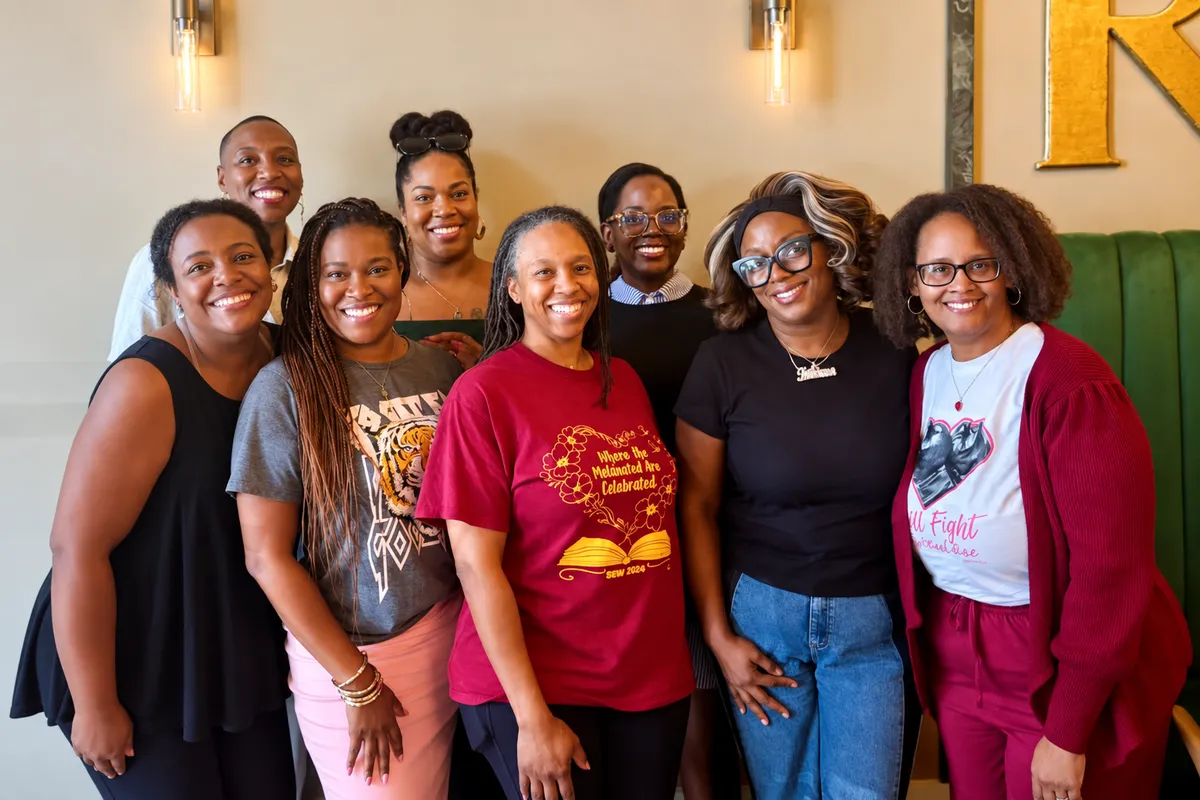
I am part of a private community of Black women authors in Atlanta, and that group has taught me something else. Community is not only about solving problems. Sometimes belonging looks like being comfortable enough to play together.
Earlier this month, several of us met in person. I walked into the restaurant with one very sophisticated thought running through my head: all these badass author girlies are in one place, and I need to capture this.
So I asked everybody to give me a quick two-second clip. Give me a shimmy. Give me some personality. Give me something I can use. The finished collaboration became exactly the kind of energy I had in my head.
At the same gathering, my homegirl Carla DuPont had another idea. She wanted each author to show some of the sensuality connected to the type of romance she writes. She took those clips and created an entirely different piece of content.
Then Denise Essex came up with another idea later. Everybody film yourself opening your refrigerator and pulling out your book.
Why was the book in the refrigerator?
I don't know. Social media be social media-ing.
But everybody did their part, Denise assembled the content, and once again we created something together.
That taught me that participation is bigger than showing up. Sometimes a woman is present. Sometimes she contributes knowledge. Sometimes she brings an idea. Sometimes she helps someone else. Sometimes she creates something with the group that would not have existed otherwise.
The real value was not just that the posts performed well. The relationship made the collaboration easy enough to try. There was enough comfort in the group for someone to say, I have an idea. Y'all want to do this? and for everybody else to say, Bet.
That is a form of belonging too.
“You Forgot to Call Me a Bookie”
The Booked Club gave me one of my favorite examples of what happens when an identity stops belonging only to the person who created it.
We call our members Bookies.
When I first started introducing The Booked Club during webinars, I would say it a little kitschy: “And yes, we call our members Bookies. Hey, Bookie!”
When somebody joined, I would shout her out as a new Bookie.
Except sometimes I missed somebody.
And they would let me know.
“You didn't call me a Bookie. I need my shout-out.”
That was when I realized the name had crossed a line. I may have created it, but they had started claiming it.
Now when new members come in, I ask the existing group to help me welcome our newest Bookies, and they call each other Bookies too.
A name by itself does not create community. I could name everybody on my email list tomorrow and that would not suddenly make them feel like they belong to one another. But when women start using the identity themselves, notice when they are not acknowledged by it and participate in welcoming the next woman into it, something has changed.
Belonging includes an expectation of recognition. It is not about needing attention. It is about knowing who you are in a room and trusting that the room knows who you are too.
The Hard Part: People Can Love the Idea and Still Do Nothing
This may be the most humbling thing I have learned.
People will tell you an idea is amazing. They will mean it. And then they will not come.
They will not buy. They will not post the picture. They will not leave the comment. They will not book the retreat.
Inside The Booked Club, we can post something as simple as, “Show us a picture from your last trip,” and still have people sit back and wait. No money is involved. No passport. No plane ticket. The picture is probably already in somebody's phone.
Sometimes I think they are waiting to see whether somebody else will go first.
That taught me that participation thresholds are not always financial. Sometimes they are social. Nobody wants to be the only person dancing when she is not sure whether this is a dancing room.
Then there are the bigger asks.
I absolutely thought my Paris writing retreat was going to eat.
Writers. Paris. Creativity. Travel. Community.
I looked at all the pieces and thought, Why would people not want this?
Well, they did not participate.
I have had similar experiences with larger retreats. Women will tell me they love what we put together, but the price can feel like a bridge too far. That does not necessarily mean the experience is wrong or that they were lying when they said they loved it. It may simply mean I was treating two different pieces of information as though they were the same.
“I love this idea” and “I am willing and able to do this” are not the same thing.
That distinction has changed the way I think about participation. Enthusiasm tells me something resonated. Action tells me whether a particular invitation crossed that woman's participation threshold at that particular moment.
Sometimes the cost is money. Sometimes it is time. Sometimes it is vulnerability, uncertainty or social courage. Sometimes I may simply be asking women to make too large a leap too early.
I am still figuring that out.
Price Is Not the Same Thing as Commitment
The Booked Club and The Chapter Lounge taught me this in two very different ways.
When I launched The Booked Club, I was terrified to ask people to pay $97 a month. I knew what the membership included, and I was still extremely cost-conscious about asking someone to make that commitment.
About a year later, I realized I was probably not charging enough. We increased the monthly price to $117.
Membership did not suddenly stop.
Then I built The Chapter Lounge at $7.99 a month.
My ego told me, If I build it, they will come.
Readers want access to writers. Writers need access to readers. The concept made perfect sense to me. The price was low. I even invited founding authors in for free to help us get started.
And then?
Crickets compared with what I expected.
There are people participating, and some of the relationships I have described in this article grew there. But the low price did not automatically create the level of participation I assumed it would.
That experience forced me to stop treating price as the whole answer. I cannot say price does not matter. Of course it does. But price alone does not explain participation.
A $117 community can generate engagement. A $7.99 community can struggle to generate it. Free access does not guarantee it either.
The thing I am paying more attention to now is relational commitment.
Is a person willing to invest herself in the group?
That may involve money, but it may also mean time, contribution, consistency, vulnerability, help or simply choosing to come back. A purchase is a financial decision. Belonging is relational.
They can overlap, but they are not the same thing.
Trusted Influence Usually Happens Quietly
This is also where my understanding of influence has changed.
In 2026, I surveyed eight Booked Club members about how they travel, make decisions and share recommendations. Eight is a small sample, so I am not going to pretend those responses represent all Booked Club members, Black women or anybody else. What they give me is directional first-party evidence about those eight respondents.
Seven of the eight said people ask them for travel recommendations at least periodically, and five said it happens pretty often or all the time. Seven said they tell friends and family when they love an experience. Private texts, group chats, conversations and other personal networks were important ways those recommendations moved.
That tracks with what I have watched happen in real life.
Janice Burns joined The Booked Club on August 9. Within about a month, she came to me because she had a Portugal trip coming up for six, potentially eight, women. She did not want to plan it.
We worked through the trip, and as the plan came together, Janice decided she did not only want an itinerary. She wanted me to manage it. She was willing to pay for my time and expertise because what she had already experienced gave her enough confidence to trust me with more.
Then Janice spoke with another woman she had considered inviting to Portugal. The timing did not work for that trip, but the woman wanted to go to Australia.
Janice told her she should talk to me.
That woman was Sheila McFadden.
Within about a week, Sheila reached out and paid for a travel Power Hour so we could start working through her Australia trip.
What interests me most about that story is not the sale. It is the transfer of trust.
At the beginning, Sheila did not know me through her own experience. She trusted Janice's judgment about me. Janice essentially lent me some of her credibility.
Then it became my responsibility to earn Sheila's trust for myself.
That, to me, is trusted influence.
It does not require a public post, a huge following or somebody calling herself an influencer. Sometimes it is simply one woman trusting another woman's judgment enough to act before she has firsthand evidence of her own.
What I Believe About Community Now
I used to think that if I created enough value, people would naturally participate.
I do not believe that anymore.
I believe I can create the room. I can create consistency. I can give people reasons to gather. I can create rituals, opportunities, names, experiences and invitations. But I cannot manufacture what women will choose to do with one another once they get there.
I cannot force Reese to help Tammie. I cannot make experienced Bookies return to help newer members. I cannot make women claim the word Bookie as their own. I cannot make a retreat sell because the idea sounds wonderful, and I cannot price somebody into belonging.
What I can do is pay attention to the conditions that make connection more possible.
I can make room for women to contribute instead of only consume. I can make room for somebody to say, “I need help,” and another woman to answer, “I got you.” I can make room for discovery, play, recommendations and ideas that did not start with me.
And I can keep learning from what women actually do instead of only what I expected them to do.
I am still learning what people want from community, what they have the capacity to give to it and what I have the capacity to give as the person responsible for holding some of these spaces.
But one thing has become clear to me.
Sometimes the strongest evidence that a community is working is not that everybody is looking at the person who built it.
It is that, for a little while, they are too busy talking to each other.